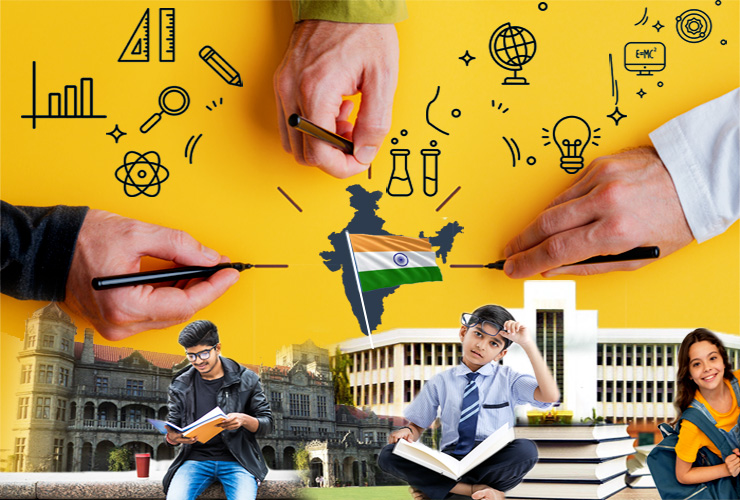
The purpose of Education is to make good Human Beings with skills and Expertise. Enlightened human beings can be created by teachers. – A.P.J. Abdul Kalam
The world is engaged in the roll-coaster of changes in the domain of Education. The human world is empowered by the technologically sustained changes. With the scientific and the technological advancements and the rise of machine learning and Artificial Intelligence, the nation has taken yet another step for building a better tomorrow. The National Education Policy 2020 focuses on the growing developmental imperatives of the country.
Indeed, with the quickly changing employment landscape and global ecosystem, it is becoming absolutely critical that children not only learn, but understand the importance to learn. Education, thus has to be more practical critical, incur problem solving capabilities, creative, and adapt changing fields with the least focus on content.
The National Education Policy is Education 4.0 – The Innovation producing Education. The Industry 4.0 focuses on revolution based on cyber Physical systems. The industry 4.0 emerges into creating spaces for students for engaging in the creative self and to learn to critically analyse. The education 4.0 ecosystem helps us in experiential learning with the help of Dynamic technology. NEP helps to Recognizing, identifying, and fostering the unique capabilities of each student.
Everything comes with its pros and cons – The challenges faced by NEP 2020 are:
India today has around 1,000 universities across the country. Doubling the Gross Enrolment Ratio in higher education by 2035 which is one of the stated goals of the policy will mean that we must open one new university every week, for the next 15 years. Opening one University every week on an on-going basis is an undoubtedly massive challenge.
In short to conclude with, the new education policy (NEP-2020) has come at the right time and the objective is very noble. But there lies a world of difference between laying down a policy on paper and following it in spirit. The success of NEP 2020 and the pace of its implementation depend to a large extent on how successfully the Universities, Colleges and Schools can tide over the practical challenges facing it. Currently, the implementation of the education policy requires multiple actions and initiatives to be taken by different bodies systematically.
“CHANGE DOES NOT HAPPEN WHEN CIRCUMSTANCES IMPROVE, CHANGE HAPPENS WHEN WE DECIDE TO IMPROVE THE CIRCUMSTANCES.”
Pro-Vice Chancellor at MIT-WPU. Architecting the future where Innovative Technology meets Indian Talent to build the India of Tomorrow.
© 2026 Dr. Milind Pande. Empowering India Tomorrow. Governance Compliance