In today’s interconnected world, the gadgets in our pockets, the cars we drive, and the software we use daily are rarely the product of a single nation. They are the result of a complex, invisible web of deals known as Free Trade Agreements (FTAs).
While they often sound like bureaucratic paperwork, FTAs are actually the “operating system” of the global economy. Here is how they work, why they matter, and how they are evolving in 2026.
1. What Exactly is a Free Trade Agreement?
At its core, an FTA is a pact between two or more nations to reduce barriers to imports and exports. In a world without these deals, countries often protect local businesses by hitting foreign goods with taxes (tariffs) or limiting quantities (quotas).
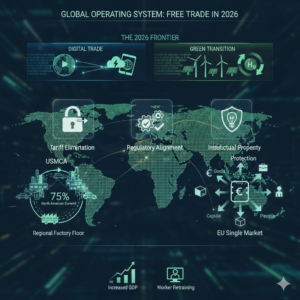
An FTA works by addressing three specific friction points:
2. How FTAs Supercharge the Economy
Free trade isn’t just about moving boxes; it’s about creating a more efficient and competitive economic environment.
Lower Prices and Better Variety
When tariffs vanish, the cost of imported goods drops. This increases the “real income” of households—when you pay less for a laptop or groceries, you have more money to save or spend elsewhere in the economy.
The Power of Specialization
FTAs allow countries to focus on what they do best—a concept called Comparative Advantage. If Country A excels at high-tech engineering and Country B is an agricultural powerhouse, an FTA allows both to specialize, preventing the economic waste of trying to “do it all” inefficiently.
A Magnet for Investment
Investors love stability. An FTA provides a “Legal Anchor,” guaranteeing that trade rules won’t change overnight. This often leads to a surge in Foreign Direct Investment (FDI), as companies feel safe building factories and offices in signatory nations.
3. Real-World Powerhouses: USMCA and the EU
To see these theories in action, we can look at two different models of integration:
4. The 2026 Frontier: Digital and Green Trade
As we move through 2026, FTAs are evolving to meet the challenges of the digital age and the climate crisis.
5. The Balanced View: Managing the Transition
While the net effect of FTAs is overwhelmingly positive for national wealth, the transition can be difficult. Competitive imports can hurt legacy local industries. The most successful nations use the wealth generated by trade to fund worker retraining programs, ensuring that the “losers” of trade today become the “innovators” of tomorrow.
Conclusion
Free Trade Agreements are more than just legal documents; they are commitments to a shared future. By reducing the cost of distance and the friction of bureaucracy, they enable the cooperation required to solve global problems—from lowering the cost of living to accelerating the shift to clean energy.
Pro-Vice Chancellor at MIT-WPU. Architecting the future where Innovative Technology meets Indian Talent to build the India of Tomorrow.
© 2026 Dr. Milind Pande. Empowering India Tomorrow. Governance Compliance